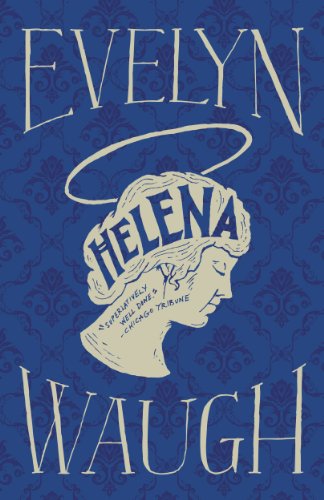
Helena is a novel by Evelyn Waugh of Brideshead Revisited fame. Waugh was raised Anglican, became an agnostic for many years and around the age of 30 converted to Catholicism. Helena is his fictionalized story of St. Helen, the mother of Constantine and the supposed discoverer of the True Cross, a famous relic, pieces of which are found in many churches.
This book was my Classics spin for the Classics Club, which gives me until May 31 to finish the book. However, it only took me three days to read. I found it very hard to put down and it is not at all a long novel.
 |
| From the BBC series Brideshead Revisited. One of the best adaptations ever. But the book is still better! |
Waugh is a master wordsmith. His precision in creating characters and the mood of the novel, the dialogue, the pacing, the deeper story going on, all the while conveyed in the subtlest way, is really captivating. Waugh says this was his favorite novel. I can see why. Waugh moves deftly in telling a fictional tale of a young girl married off to a Roman soldier without any idea of who he really is. He is of the great families that struggle to rule Rome. He bides his time and eventually, after decades, gains control. At first Helen is happy and in love. She bears him a son, Constantine whom she raises lovingly in her palace in Asia Minor until he is 14. She is a clear sighted soul, who sees the evil the murderous power struggle that is eating the Roman Empire for what it is. She is never seduced by power. Instead, in her pagan way, she longs for truth. She longs for a reasonable answer to her deeper questions. She is of a stoic bent though and accepts her lot and the heartbreak it brings.
Throughout the book the rise of Christianity is hinted at. it is mentioned here and there, but most people seem to have it all wrong. It is all twisted up with a pagan understanding, seen as just a cult like the many other cults that are brewing at the time. Constantine has his vision of the cross and wins the Battle of Milvian Bridge. But he's all twisted too. When Helena is allowed to visit him in Rome after years and years of never seeing him, she sees what the sordid insanity of Rome has done to him. There are glimmers of the old Constantine, her child, but his mind has been demented by so much killing, manipulating, spying and paranoia. He's banking on Christianity though to bring his kingdom together.
I felt the same admiration for Waugh in the way he presents the sordidness of Rome without ever really depicting it graphically, as I did when I read that great novel of early Christianity, Quo Vadis. The reader feels how utterly creepy and unhinged the whole atmosphere must have been, thus making the intelligent charity of Christianity seem like such a breath of fresh air. One can see why it was so very attractive and why it gained in popularity. The world was suffocating under the unmitigated vice of the Roman world.
 |
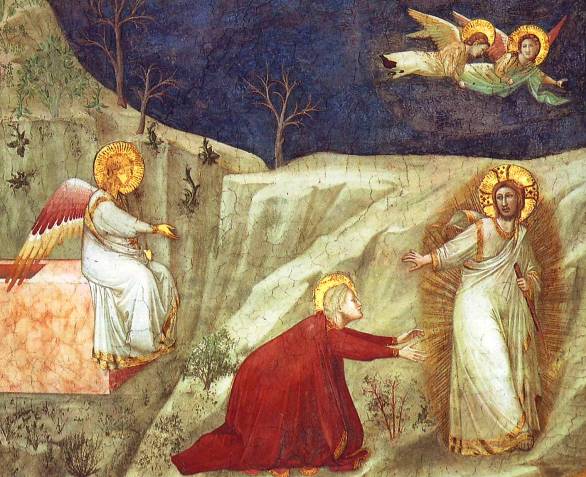
| St. Helen finds the True Cross |
Helena finally finds her purpose in her old age. She converts, Waugh doesn't go into details at all, with great effect. Instead she pursues her final goal, to find the true cross. Waugh also uses anachronisms to great effect. He's playing with our sense of history. At one moment we are in the 300s A.D. but at other moments we in the 20th century looking back and using analogies from our own time to illustrate what's taking place. He does this seamlessly without any feeling of strain for the reader to jump in time that way. That to me was masterful storytelling.
The one disturbing irritant in Waugh's writing is that he always brings in the British sense of superiority/bigotry in the way he depicts blacks and Jews. He was unfortunately a man of his time in that way. He always seems to have to get a few digs in. So there's a great inconsistency in his faith; he so deeply understood so much of it, as is evident in the power of his writings, yet he never could overcome the cultural bias he was raised with.
In spite of that, I thoroughly enjoyed this novel. For more book reviews, go to Read 52 Books in 52 Weeks.