Sunday, February 16, 2020
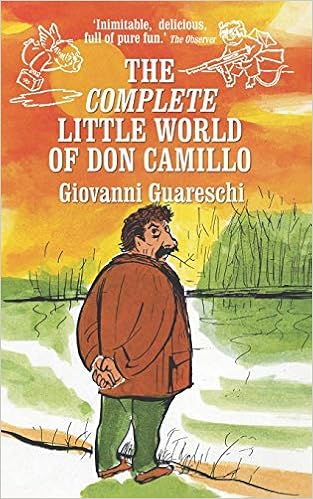
The Complete Little World of Don Camillo - Book 4
This book was a reread for me, except that this new edition had previously untranslated material in it, so there were new stories included.
Don Camillo is a priest in a little town in the Po River valley in Italy, just after World War II. He is a large, powerfully built man with a hot temper and a deep love for Jesus Christ. This book contains loosely tied together short stories based mostly on the ongoing feud between Don Camillo and the Communist Mayor of the town, Peppone. Don Camillo and Peppone are almost like two peas in a pod they are so similar in temperament, but one has chosen the communist route and the other the Church.
I found this book delightfully humorous and touching. Don Camillo means well but he often slips up because of his ferocious temper when it comes to anything anti-Jesus and his Church. A lot of comical situations crop up but underlying it all are the poor Italian people so traumatized by Il Duce, the Nazi occupation, the war and now the aftermath. The government is still unstable with communists and many other parties trying to gain control. The landscape still has mines left behind by the Germans, people carry weapons with them, machine guns and other weapons of war. There is violence and loyalty, feuding and kindness, all wrapped up in a complicated package.
The third main character in the book is the crucified Christ on the cross over the altar in the church. Don Camillo talks to him as a friend and Christ responds in turn with gentleness and good humor, understanding, sternness, and like a father shaking his head over a young child's escapades.
The author, Giovanni Guareschi, was a reporter and cartoonist who was arrested by the Fascists for being politically incorrect, then hauled off to a prison camp by the Nazis for refusing to fight for them and finally after the war, he got himself in trouble for being a little too scathing with his satire of the then new government. He wrote these stories based on a priest he met at prison camp, named Don Camillo, who was there because he was caught helping Jews escape to Switzerland. Much impressed by the character of the man, he began to write stories about him, setting him in a fictional town very much based on Guareschi's own town where he was born and raised in the Po Valley.
Only a few of the stories had been translated into English before this, but they are considered modern classics in Italy. Now there is a new set of translations so that all five volumes of the collection can be read for the first time in English. I got the first three volumes for Christmas.
I highly recommend this book! It's a treasure!
For more reviews, go to Read 52 Books in 52 Weeks.
Sunday, February 2, 2020
The Tempest - Book 3
The Tempest by William Shakespeare was my latest Classics Club Spin read. I managed to get it read in time for the challenge. I enjoyed it. I had seen the play several years ago in Washington DC. The staging and the sound and light effects were really well done. It was a great production that I thoroughly enjoyed, even though I was not that familiar with the story. Ever since, I've been meaning to read the play. Now I finally have!
Some of the well known phrases that come from this play:
'sea-change'
'the past is prologue'
'into thin air'
'the stuff that dreams are made on'
'brave new world' which is not depressing as in Aldous Huxley's book (which I've never read) but is something Miranda blurts out upon seeing that there are more of these wonderful creatures, men, than just her brand new husband, whom she's only known for 3 hours, Ferdinand (the first man besides her father, she's ever seen).
The story is about Prospero who has been deserted on an island with his young daughter, by his evil brother Antonio and his colleagues who helped him. Ever since, Prospero has been planning revenge. He has two magical servants or slaves: Caliban, who is the son of a witch and Ariel, who is a sprite of some sort. Prospero has been studying a lot and knows magic, so when finds out that his enemies are on a ship nearby, he whips up a tempest to cause a shipwreck. Various passengers and mariners are washed ashore. No one dies, some get drunk, Ariel is very obedient in carrying out Prospero's wishes, Miranda the daughter and Ferdinand, son of a Duke, fall in love at first sight, and Prospero weirdly just kind of shrugs and says, he's over his anger as long as he gets his Dukedom back and abruptly forgives everyone, even if they don't seem to deserve it.
I feel like the plot was going a particular way but then Shakespeare decided it was getting too complicated and long so he just had Prospero change his mind! In spite of the weird plot pacing, there is much to love and laugh about in this play.
Two thumbs up! For more book reviews go to Read 52 Books in 52 Years
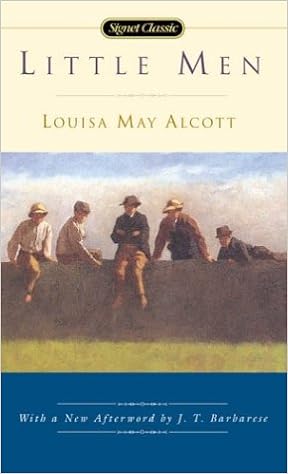
Little Men by Louisa May Alcott - Book 2
Little Men by Louisa May Alcott is the next installment in what turned out to be the 3 novels centered on the character of Jo Bhaer (nee March). In this novel Jo is married to Professor Bhaer and is busy helping to run a boys's school in the house she inherited from Aunt March, Plumfield.
I enjoyed this book immensely but I do think if the reader goes into it expecting similar adventures of Jo as in Little Women, he or she will be disappointed. Alcott isn't nearly as interested in Jo's problems. Mostly this book seems to be a tribute to Bronson Alcott and his theories of education. This book shows a great warm affection for children and how they learn. And all sorts of kernels of later developed educational theory can be found here from Montessori to Charlotte Mason. Bronson Alcott was ahead of his time, at least as told through the lens of his daughter Louisa May, because Jo and Professor Bhaer's way of teaching and respecting children is far from the more stern and highly regulated Prussian or factory way of educating children. While lessons are part of the landscape, the children have lots of free time to explore and learn on their own. They are free to express themselves without fear of condemnation or harsh criticism. Jo and Prof. Bhaer are just as concerned with virtue as with learning. They don't expect every student to be an academic, but they do want every student to grow in integrity and in the ability to think for themselves and stand on their own two feet. Kindness, affection, forgiveness, honesty, gentleness are the tools that they use to instill good behavior and form their students' conscience.
I did have a bit of trouble with Louisa May making a clever consequence of bad behavior always efficacious when it came to the child repenting and realizing their flaw. I don't think it always works that tidily in real life! Also, I recoiled a bit from the sort of Svengalian pride that Jo's takes in shaping her students.. But I think that reflects the Transcendentalist optimism in the perfection of humankind. If we just have the right formula everyone will turn out to be perfectly good!
There are many funny and warm situations in this book between and about the various children. I thoroughly enjoyed revisiting Plumfield I wish I' d gone to school there!
Two thumbs up! For more book reviews go to Read 52 Books in 52 Weeks.
Subscribe to:
Posts (Atom)