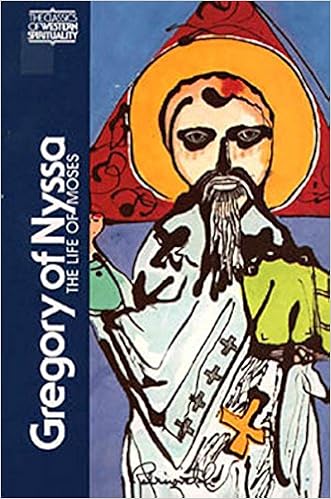
The Life of Moses by Church Father St. Gregory of Nyssa is a retelling of the story of Moses from Exodus, with a line by line fleshing out of the theological significance of every aspect. Moses is a pre-figurement of Christ in many ways but also his story reflects everyone's spiritual journey to union with God.
The book begins with a long summary of the whole story of Moses' life. Then St. Gregory goes back to the beginning and methodically and in rich language works through the theological implications of everything. I googled around to see what others thought about this and found this review which I strongly disagree with! I did not find this a difficult book, nor did the idea that there are layers of meaning in scripture that can be found by analyzing the text in different contexts a strange idea.
For instance, when St. Gregory talks about the puzzling language that attributes to God the idea that he (God) hardened Pharaoh's heart, the author (St. Gregory) says in so many words, how can this be? God does not force people to sin and what was Pharaoh doing when he rejects Moses's plea and continues to oppress the Hebrew slaves, but sin? St. Gregory attributes this to a fault in the language. In a larger sense, because God knows all, He knows that Pharaoh will reject Moses. But because God is all good as well, he can not force someone to sin. So therefore St. Gregory sees the language of 'God hardening Pharaoh's heart' as a poetic expression, rather than an accurate theological one. Instead he says, look how merciful God was! He gave Pharaoh 10 chances. He showed his power, he showed Pharaoh the consequences of rejecting him and each time Pharaoh threw the chance away, until the worst one. And even then, he did not truly repent but came after the Hebrews and his army wound up drowning in the Red Sea.
The part of the book that really sang to my soul was when St. Gregory uses Moses' relationship with God as a prototype for everyone's path to holiness. Moses was humble and obedient; he didn't understand much but he trusted and loved and longed to see God's face. His trust, love and longing make him bold and steadfast. Here's quote that jumped out at me.
This sort of experience I believe to belong to a soul which truly loves that which is beautiful. Hope continually pulls the soul from the excellence which is visible to what is beyond, always igniting a longing for the secret by what is readily seen. So the true lover of excellence, although obtaining what is always manifest as an image of what yearns for, yet still yearns to be filled with the very likeness of the archetype.
And the bold demand which ascends the mountain of desire seeks this: to enjoy the beauty not from a mirror or reflection, but face to face.
Our longing for God can never be satiated in this life. But that longing itself serves to inexorably call us closer and closer to holiness.
Another example of how St. Gregory interprets the story: when Moses asks to see God and God replies that if Moses saw him he would die, but then God allows Moses to see God's back as He passes by. St. Gregory puzzles over this. How can to see God's face mean death, when God is the creator of life, I am that am, in fact, very existence itself! He then interprets this to mean that 'death' in this case is something that is beyond this life. Moses, in other words can not grasp or understand what God truly is, just as someone who is dead is now beyond us, so God is beyond our comprehension. However, by viewing God's 'back,' Moses becomes a true follower. If someone is guiding us, leading us, then we follow that person, keeping his back in sight so we know we are following the right way.
I read this book on my kindle and like many e versions of old texts that are free or very inexpensive to purchase, the text is rife with typos. This is frustrating! I don't understand the sloppiness involved here. Did people think readers who wanted to read old classics don't care about accuracy and being able to comprehend the sentences? Did no one bother to proof read? So there were certainly some passages in this book that were obscure, not because of St. Gregory's writing or analytical style but because the text was poorly transcribed. For this reason I am not linking to the Kindle version but one put out by a usually reliable publisher. Hopefully that translation and transcription is of a better quality.
Since reading the City of God by St.Augustine (a mammoth task for me!) I have come to really appreciate how the early Church Fathers blended the natural reasoning and law discovered by the great Greek philosophers with the basic precepts of Christianity. What a gift they have given the world! Because faith and reason can never contradict each other, both are given of God, the early fathers presented us with a gigantic gift that so much flows from, even to the Enlightenment and the birth of science!
I highly recommend reading The Life of Moses. For more book reviews go to Read 52 Books in 52 Weeks.

No comments:
Post a Comment