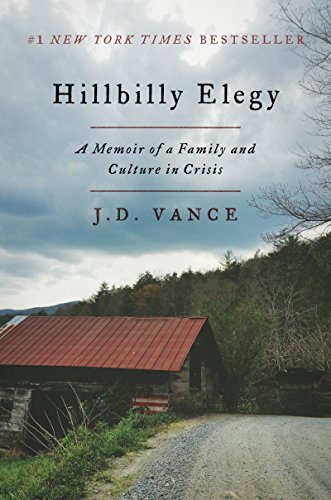
Hillbilly Elegy by J. D. Vance is a memoir about growing up in a transplanted Appalachian, poor white trash family. The author's people come from deep in the Appalachian hills of Kentucky. As a boy he spent summers and holidays there playing in the hollers with his kinfolk. But his grandparents had migrated to Ohio right after World War II to work in the steel mills. This was a big migration where whole extended families moved taking their culture with them. When the factories started shutting down and the economy crashed, these people were left stuck. They'd bought houses they could not sell. The towns began to deteriorate; crime rose as booze and drugs became more commonplace.
According to the author though, who loves his family in spite of the fact that it is and was so painfully dysfunctional, there are also other factors at play. The Scotch-Irish clannishness of the hillbilly and the long years of poverty in one of the poorest areas in the U.S. developed a culture that had both good and bad qualities, but the bad qualities are extremely destructive. A misplaced sense of honor that would rather seek violent revenge than do any self-reflection, the idea that one's loyalty is above and beyond to one's kin, even if they might kill you in a drunken rage, the suspicion of anyone who is an outsider, the degrading effect on being on the government dole from generation to generation all have taken its toll on the white working class in the rust belt. This is where heroin use has skyrocketed, where the white men and women's life span has been decreasing even as the country around them has people living longer lives. These are the people that turned out to vote for Donald Trump. They are dying and are desperate for change. They feel forgotten by the rest of the nation.
The story is told in a very absorbing, emotional way. Vance recalls all the beatings, the fights, the trauma, the many husbands and boyfriends of his mother (who eventually winds up a heroin addict). It is a harrowing story, but he is saved by some elements of the very culture he realizes is working to destroy him. This book is him trying to sort things out. The fierce clan loyalty means he has a big network of people who loved him and who were there to rescue him when he needed it. His grandparents, Papaw and Mamaw were especially instrumental in this. They gave his life some stability. His older half-sister tried to protect him from his mother's rages and outrageous selfishness. Even his mother, when she was going through periods of stability, helped. She got him a library card and encouraged him to read, she taught him about strategy when they both became huge football fans. His Papaw played math games and puzzles with him which helped Vance in school. In high school, when he was beginning to drift, skipping classes, drinking and dabbling in drugs, his grandmother took him in and gave him a regular home. He found this to be such a help in being able to focus on schoolwork. Almost every year of his life he was moving from one place to another, depending on his mother's husbands and boyfriends and whether she was starting a relationship or breaking up one. Just the fact that for the last three years of high school he could come home to the same safe haven where he knew he was not going to have to confront any fighting or violence, made him do better in school.
He didn't know what he wanted to do when he graduated. He did just well enough to get into Ohio State, but he was afraid of going off to college. So he joined the Marines instead. This was a great decision for him, as it really forced him to become disciplined and to see what life was like outside his hillbilly culture. He loved it. After serving for four years though, he had the courage to attend college. But after being out in the world, fighting in Iraq, he couldn't quite get into the younger culture of college, so he completed his 4 year degree in less than two years, barely sleeping. On a fluke he decided to apply to Yale Law School, not thinking he'd get in, but he did! That was another cultural shock, going from the working class rust belt to the Ivy League.
This book is really full of love and soul-searching. The author is trying to be fair to his family while at the same time trying to pinpoint what the hillbilly culture gets very wrong. He hardly talks about racism, which I found to maybe be a bit of a blind spot. But he does talk about how similar the dysfunctions of inner city black families are to the dysfunctions of the rust belt/hillbilly transplants. The author calls himself a conservative, but he notes the different government programs that really do help the poor and that he is grateful for since they did give him a boost up. He decries the children's protective services which really don't function in reality and often cause more damage and trauma than not. I was impressed at how honest and fair the author was striving to be.
I read this book in a couple of days, it was that absorbing. Lots of traumatic childhood violence and bad language, but also lots of love, compassion and gratitude as well.
I highly recommend this book!
For more book reviews, go to Read 52 Books in 52 Weeks.

No comments:
Post a Comment