Sunday, November 3, 2019

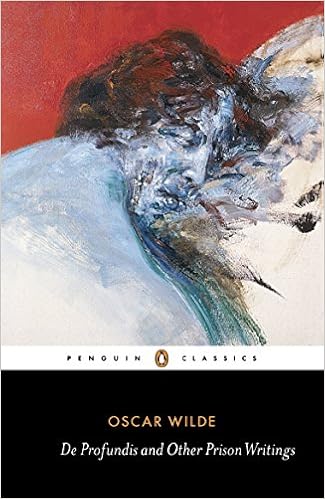
De Profundis - Book 48

I actually read a free kindle version that only had De Profundis and not the other writings.


De Profundis is really a long letter written to Oscar Wilde's lover, Lord Arthur Douglas.  Douglas was the one who precipitated Wilde's trial and imprisonment.  There is reason to think he, though 16 years younger than Wilde, influenced Wilde to do really degenerate things.  And he sponged off Wilde financially causing his bankruptcy.  And yet after Wilde's release from prison when he was living in poverty in exile in Paris, and Douglas came into his inheritance, Douglas would not help Wilde out at all.  He completely rejected him.  Poor Wilde, Douglas was a scumbag and Wilde's obsession with him is tragically pathetic.

The Latin phrase 'de profundis' means 'out of the depths' and refers to the divine office reading for the dead.  Wilde, during his two year imprisonment was full of self-pity even as he strove to overcome his bitterness and make his tragic fall about something higher.  It vacillates between noble ideas of art and faith and feeling sorry for himself for being so (in his eyes) unjustly condemned.  On the one hand some of his writing absolutely soars like a gorgeously sung aria, but on the other hand, his narcissism bleeds through, his tragic flaw that was Wilde's undoing is there on display quite poignantly.

The saddest thing is that the letter ends on a high note, with Wilde hoping his art will never abandon him and yet, he really was finished.  His last few years were spent in poverty and exile, drinking beyond his means, literally begging for money on the streets of Paris.  His wife had died.  His mother died while he was in prison, her death possibly hastened by his downfall.  He was never allowed to see his children again.  Though when he cries out about that in De Profundis, I felt angry at him!  Because he did not care enough about the children to be faithful to their mother or to even spend time with them.  He would go off for months and not bother to even spend Christmas with them some years.  He was too busy leading his double life and diddling with teenage prostitutes.  I think he liked the romantic idea of childhood, but his narcissism prevented him from any sort of healthy love.  He could be kind and charming when in the mood and his sons had that memory of him.  His oldest son was killed in World War 1.  His youngest though went on to live a long and successful life.

Just as I was reading this book, one of my sisters unearth old footage of my father's Navy squadron from World War II.  He was a fighter pilot and participated in both the Iwo Jima and Okinawa battles. He was shot down in one of them, though I don't know which.  Luckily he was only in the water a couple of hours before a ship saw him.  But when I think of all the sacrifice so many unknown men made, when I think of other prison accounts like St. Paul's or Nelson Mandela's, or someone like Father Walter Ciszek spending decades in a Soviet prison and gulag and how lacking in self pity they were and they were indeed, unjustly imprisoned, Wilde comes off as a real wimp.  Poor little rich boy.  Today is All Soul's Day though and I find myself praying for Oscar Wilde.  He could glimpse the beatific vision, but he was so lost in his own narcissism, he wasted so much.  On his death bed, he converted.  May he rest in peace!

For more book reviews go to Read 52 Books in 52 Weeks.

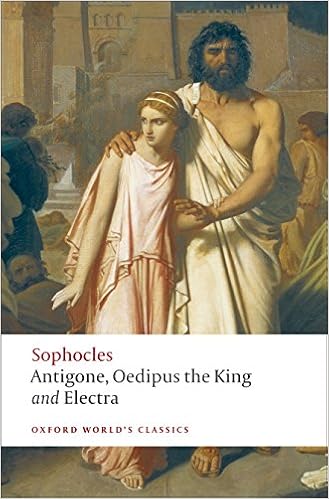
Antigone, Oedipus the King and Electra - Book 47


I read this collection of plays by Sophocles.


Antigone is the first play in this book, though chronologically it takes place after the events of the 2nd play, Oedipus the King.  However, apparently Sophocles wrote it first so the Oxford World's Classics ordered them according when Sophocles wrote them and not when they occur in the time line of the trilogy.

Antigone to me is about the fact that natural law is higher in authority than man made law.  If the man made law jives with the natural law, that law written on the human heart that people naturally intuit, then the man made law is just.  If the man made law contradicts the natural law, then one's allegiance is to the natural law.

Backstory:  Oedipus Rex and his wife/mother Jocasta are now dead.  Their four adult children live, two men and two young women.  The brothers take different sides in a civil war and wind up killing each other on the battlefield.  The two sisters, Antigone and Ismene are now bereft of their brothers.  Creon their uncle has assumed the throne and he immediately promulgates a law that Polyneices the brother who fought against Thebes, should not be buried according to the rites deemed crucial to entering the underworld.  Antigone defies this proclamation and tries to bury her brother anyway.  Ismene makes a plea for the authority of Creon, whether right or wrong.  Antigone was engaged to be married to Haemon, Creon's son.  Creon is insecure in his power and leadership since he has just ascended to the throne so he is fairly paranoid that people will defy him.  He first hears Antigone's defiant statement of guilt for doing the forbidden act of burying her brother.  Then he hears his son, who starts off being obedient and respectful but gets so incensed at his father's pigheadedness, he winds up breaking with him.  Then the blind seer Tieresias comes in and also gives a pretty blunt warning.  Even though Creon doesn't want to lose face in front of the prophet, as soon as he is gone, he turns to the chorus and admits that now he's frightened and he better undo what he's done.  But alas too late.  He had sealed Antigone up in a cave to starve to death. When he hurries to release her after his change of heart, he finds a tragedy.  Antigone has hung herself.  And his son Haemon is weeping over her body.  In a rage at his father he lunges at him and then realizing what he's done, he turns his sword on himself and kills himself right in front of Creon.  Creon's wife Eurydice hears of the suicide and runs into her palace to kill herself.  Poor Creon.

Why did the translator sometimes use God with a capital G and sometimes use god?  I found that odd.

Oedipus the King

Problems I have with Oedipus.  First of all he shouldn't have murdered anyone on the road from road rage!  Doesn't this show a bad side to his character?  Why isn't this enlarged upon?  It's the idea that he accidentally killed his father, which he was actively trying to avoid doing, which seems to be a greater sin than just losing his temper and murdering 5 people on the road one day.  This strikes me as off!!!  Also, didn't he notice that Jocasta was old enough to be his mother?  I mean I think that if I had been warned that I might marry my mother, even if I assumed (from incomplete knowledge) that this wasn't my mother, I'd have sort of categorically refused to marry anyone who was that old!

I really think that what is missing here is the idea of sin.  Oedipus had no intent to do the things he was actually fated to do. So he is innocent in that 1) it was fate, not him 2) he tried avoid all this happening  But still even though he isn't at fault (except for killing the man on the road who turned out to be Lias his father) he is condemned and shamed, etc.  I get that the ironic twists and turns are what the play is about, but this lack of intent bugs me.

Electra

I had not read this play before so I didn't really know the plot.  However, I was a little bit familiar with the murder of Agamemnon when he returned from Troy by his wife and lover. I don't think I really knew about Orestes and Electra.

It's all about vengeance.  They kind of leave the sister of Electra hanging.  She serves as the same type of foil to Antigone's sister had served; the voice of prudence and conformity.   Also this features a sister's issue with a brother!   Electra wants her exiled brother Orestes to come back and kill their mother and lover who had murdered Agamemnon.  The irony that jumped out at me was Clytemnestra's excuse for killing Agamemnon was due to the fact that he was forced to sacrifice a daughter to the gods to save many.  But she doesn't care about any of her other children.  Another bit of irony was that Electra who has been obsessively holding on to the idea that Orestes will come back and avenge their father's murder, but then doesn't recognize him.  And she doesn't recognize the tutor she gave him to as a baby to smuggle out.

And again, the weird reference to God, ex.  'I pray to God', but then gods and names of specific gods.  Was this an example of the translator christianizing the text?

I am glad I read this!  This fulfilled my Classic Club spin.  Hooray!  Slowly working through that list of 50 classics!

For more book reviews, go to Read 52 Books in 52 Weeks


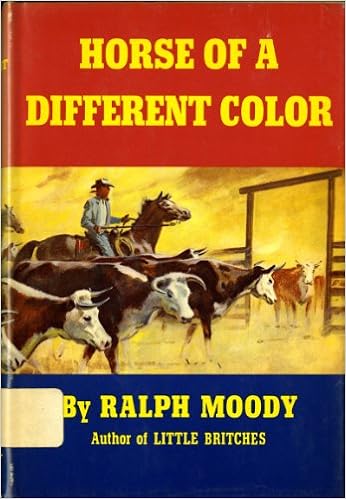
A Horse of a Different Color - Book 46


The final book in the Little Britches series, Ralph Moody continues his rags to riches (well solvency, not quite riches) ups and downs as he tries to gt himself out of debt while becoming a drover and meat processing business, first to the railroad work crews and then to local farmers.

This book really continues the story of The Dry Divide in that it takes place in the same area of Cedar Bluffs.  He wound up there after getting kicked off a train he was hitching a ride on completely broke but hoping to meet up with friends in Denver.  However, he was tossed off the train and soon became a farm hand.  I won't recount what happened in The Dry Divide except that he wound up going into business as a harvester and wheat hauler.  However, he was up to his ears in debt and dealing with the local bankers in mortgaged property and stock.  Ralph (called Bud) has an indefatigable entrepreneurial spirit.  He tries to go into business with Bob who is an irresponsible braggart.  This doesn't lead to good things.  Eventually he gets sued by the bank and must declare bankruptcy.  Then Ralph must come up with a way to start all over again.  And he does!

This book, as is typical in this series, is full of technical details of how Bud financed everything, how he set up his business, how the stock market in 1920 was doing in terms of livestock, how he dealt with the railroad and got the contract that pulled him out.  A lot of times the technical detail just went over my head, since these things are so unfamiliar to me.  I do think these books could have used some editing.  However, at the end of the book everything gets tied up neatly and it ends on a high and hopeful note.

Many of the books have a little romance thing going on between Bud and a girl.  These never move much and they don't continue from book to book.  His main helper from The Dry Divide simply disappears in this book.  I thought he was going to wind up marrying her.  Instead we suddenly hear about a sweetheart from back home in Medford MA.  So that aspect of this series was just a little odd for me.

This series is often compared to the Little House series by Laura Ingalls Wilder.  Little Britches in the masculine counterpart, except a couple decades later in time.  However, I think the Little House books are better written.  Little Britches though is a very interesting series and I'm glad I read it.  Even though all the technical details of everything from ranching, farming, wheat hauling, butchering, stock market and financing are out of my ken, I appreciated how much real history they conveyed.  I feel like I know a lot more about the nitty gritty details of managing life back in the day.  So that information is highly valuable stuff.

All in all, I really enjoyed this series of books.  For more book reviews go to Read 52 Books in 52 Weeks. 

Sunday, October 27, 2019

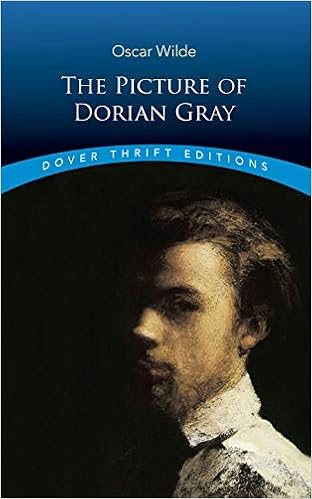
The Picture of Dorian Gray - Book 45


I read this book as part of the booktuber world's Victober, when you read lots of Victorian writing during October.  I had actually read this book back a long, long time ago but had been wanting to reread it anyway, so Victober provided a good excuse. 

The Picture of Dorian Gray by Oscar Wilde is a richly written, clever and well paced novel about three friends, Dorian Gray, a young,handsome innocent, Basil Hallwood, a painter, and Lord Henry Wooten, who basically plays a debonair Mephistopheles who lures Dorian into a life of evil.  Lord Henry is extremely witty and always turns everything on its head, morally speaking, through his entertaining play with paradoxes.  He confuses most people who laugh at him and consider him a good guest at a dinner party, but to impressionable Dorian he is wise and wonderful.  Dorian falls under his spell.  Lord Wooten grooms him and slowly seduces him into a life that thinks only of pursuing pleasure.   We then witness Dorian sinking further and further into a life of selfishness and sin.

Wilde's own life is reflected in this book.  Both Dorian Gray and Lord Wooten portray aspects of things characteristic of Wilde's own trajectory towards a sordid end.  Dorian Gray has been influenced by Lord Wooten and by a book that Wooten gives him.  Wilde had also been influenced by certain literary celebrities in the decadence movement of the Fin de Siecle era.  The book that had so much further influence on Wilde was by a Frenchman Huymans, who wrote A Rebours, which basically touted that living a life of pleasure and sensation was the only way to live a life of beauty. 

Wilde is also Wooten though as well.  Wilde loved to groom and collect beautiful young adoring men around him to worship his wit and style.  Wootens clever party repartee directly echoes Wilde's ability to be brilliantly witty.

The whole story is a morality tale that pretty much parallels Wilde's own life.  He sort of predicts his own end.  Dorian Gray, his conscience numbed by Wooten's influence and by years of doing selfish, sordid things, begins to realize that this is the path to ugliness and not beauty.  He tries to turn his life around but he is so steeped in his own narcissism, he can't really do it.  That part really reminded me of the Flannery O'Conner short story A Good Man Is Hard To Find, in that just as a character thinks they realize the true nature of evil, their completely inadequate grasp knocks them dead. 

Wilde was a gifted author.  His prose is gorgeous and flows like honey and is smooth as silk.  But ultimately it is about bored rich people's self-indulgence that spread harm and grief to many.  Poor Oscar Wilde, he gave us a lot but he has a lot to answer for as well.

In spite of the troubling nature of this book, there's a reason it is so well respected.  It is a morality tale that has so many different levels to it, one could read it over and over and discover more nuance. 

For more book reviews, go to Read 52 Books in 52 Weeks

Sunday, October 20, 2019

Callista - Book 44


I stumbled upon this book while learning more about St. John Henry Newman who was canonized on October 13th (last Sunday).  I didn't know he had written novels!  This one was published in 1855 and was actually well received.  He's fallen out of favor now, probably due to his heavily religious content. 

St. John Henry Newman was a well respected Anglican priest and theologian who lead the Oxford Movement, a movement that wanted Anglicanism to grew closer to its Christian roots.  Newman was an expert on the early church fathers.  One famous quote from him was "To be steeped in history is to cease to be protestant."  He swam the Tiber and became Catholic causing quite the stir.  He became quite influential in the Catholic church as well, though for a while he was kind of left in obscurity until his new church fellows grew to trust him and recognize his genius.  Many people say he is the greatest theologian since Aquinas.

Callista is set in the 3rd century near Carthage, but out in the boonies where Christianity has sort of faded for the most part due to early times of persecution.  The persecutions were fairly sporadic and had much to do with who the emperor (and if he had an ax to grind against the Christians) and also on local politics and power struggles. 

The main characters are Agellius, a young man who was baptized as a young child but has had not support and knows of no other Christians now that his father has passed away.  His brother who also had been baptized has come under the influence of their evil step mother.  His uncle, Jocundus, is a kind man who wants to do right but is very much of the Roman mindset and is very prejudiced against the Christians.  Jocundus employs two Greeks, Aristo and Callista.  Callista is beautiful, intelligent, spunky, clever, affectionate, witty.  Agellius wants to marry her and Jocundus thinks this will help steer Agellius further from Christianity so he facilitates the match.  But Callista has a mind of her own.

The story is set during the Plague of Cyprian.  A terrible plague of locusts that brought on much pestilence and death hit that area while Cyprian was bishop.  The people blamed the Christians and went on a rampage of persecution.  Callista gets caught up in this.

The dialogue is too formal and too expository to be natural.  The language is erudite.  Many Latin references throughout.  However the characters are surprisingly well developed, the dilemma is compellingly developed, the action keeps things moving and the theological conclusions are moving and inspiring. 

I am so glad I read this novel.  It is part of my #Victober line up.  I am enjoying becoming more familiar with the wonderful mind and soul of St. John Henry Newman.

For more book reviews go to Read 52 Books in 52 Weeks.

Sunday, October 13, 2019

The Unmasking of Oscar Wilde - Book 43


I got this book by Joseph Pearce on my kindle to go along with my 'Victober" read of The Picture of Dorian Gray.  Victober is a booktuber thing where people read lots of Victorian literature in October.  I'm not doing that much because I'm too caught up in other things, but I thought I could re-read The Picture of Dorian Gray which I've had in mind to do for a while now.  I had to get the book on hold at the library because for some reason I wanted to read it via a real book instead of via kindle or audio.  So while I waited I got The Unmasking of Oscar Wilde.

Poor Oscar Wilde.  He really was of two minds and he never successfully (understatement!) integrated them.  Most of his writing has a high moral tone, fairy tales full of wisdom, plays that explore right and wrong and yet, he at the same time, was living a life that descended more and more into reckless depravity.  Until he was finally caught and ruined.

Wilde was a brilliant scholar and literary man.  His first written work was in poetry and art criticism.  His poetry, while popular, was not particularly original.  He really gained celebrity via his witty bon mots and his outlandish, dandy style of dressing.  He became the guest to have when high society was having dinner parties.  He worked hard on this persona.  He loved attention and notoriety.  Before he ever wrote the works that he is really known for now, he was asked to give a speaking tour of the USA which he did.  He traveled all over the U.S. as well as up into Canada for over a year.  In fact his first play debuted in New York, however, it fell flat.  He hadn't gotten into the play writing groove yet.

Weirdly, Wilde's descent into decadence began on his honeymoon.  He had already been influenced by the likes of Baudelaire and now with his brand new, innocent and adoring wife, he read a book by a French author, Huysmans, who led the decadent movement in France.  This book entitled A Rebours (Against the Grain) advocated for abandoning moral principles in pursuit of sensation and pleasure.  This book inspired The Picture of Dorian Gray.  After this Wilde seems to have had his first homosexual encounter with a Canadian, Robert Ross, a man who became an English publisher (I think, if I am recalling correctly).  This man actually became a life long friend and was at Wilde's side when he died.  After this introduction into this lifestyle, Wilde became hooked and by degrees became more and more addicted to sex.  He befriended a handsome young man named John Gray who became the model for Dorian Gray.  His affair with Gray lasted a while but then Gray began to become unhappy and disillusioned.  Wilde began to neglect his wife and two sons.  He loved gathering disciples of young men around him who looked up to him as their mentor in all matters artistic and 'edgy.'  During this time though, strangely, Wilde, was writing very moralistic stuff that people couldn't really understand because it contrasted so with his lifestyle.  The Picture of Dorian Gray, The Selfish Giant, The Happy Prince, Lady Windemere's Fan, A Woman of No Importance and much poetry were rife with Christian imagery and moral lessons.  He finally was introduced to Lord Alfred Douglas who was Wilde's undoing.   A very handsome and unstable homosexual, Douglas became Wilde's obsession.  They would solicit young boys as prostitutes, often sharing them.  They traveled to Algeria to partake of the 'exotic' boys there.  Wilde was becoming more and more reckless and degenerate.

Douglas' father, Marquess Queensbury, was a volatile man who grew to hate the relationship between Wilde and Douglas.  He and Douglas' mother saw Wilde as corrupting Alfred, whereas Joseph Pearce really wonders if it wasn't more the other way around. Father and son hated each other and came to blows legally when Wilde was urged by Douglas to sue the Marquess Queensbury for libel.  This was not smart as the Marquess had plenty of evidence of Wilde's soliciting young boys.  Wilde lost the suit and then was arrested and tried, found guilty and sentenced to two years hard labor.  May I just interject here that in our day and age which is seen as less prudish than the Victorian Era, Wilde would have gotten a much harsher sentence?  He was kind of like the Jeffrey Epstein of his day, except with boys. Now we realize just how much harm seducing young men does to them. I wonder and grieve for the male prostitutes and young boys Wilde and his set preyed upon.  What damage they must have done!

Wilde suffered much during his imprisonment.  He read lots of Christian texts and Dante was the most comforting to him.  He wrote his great opus De Profundis which was a long letter to Douglas explaining everything and renouncing him.  This was published after Wilde's death.

All his life Wilde had been intrigued by Catholicism.  He had flirted with it heavily while at Oxford.  But his father threatened him with disinheritance and in fact an older half brother who pre-deceased Wilde, basically cut him out of his will because he was afraid he'd become Catholic.  So Wilde drifted away from Catholicism, even though its ethos and symbolism populated his writing.  He turned instead into a pathological sex addict bringing ruin and heartbreak to his loving wife and two children.

After prison, Wilde wound up living in France where he was a social pariah.  Some friends still were loyal but he had a lonely existence where he drank too much and wound up occasionally soliciting male prostitutes.  He literally was reduced to begging because he could not stay within his limited income.  His wife died, he never saw his children again. and then all his decadent literary circle of friends began to die.  John Gray who had been the model for Dorian Gray became a priest!  The man who wrote the book that inspired Wilde to indulge in decadence, converted to Catholicism!  In fact all those fin de seicle decadent artistes, like Aubrey Beardsley converted and then died tragically.  Wilde's own mother, whom he always loved, died a broken woman while he was in prison.

Wilde didn't last long as a has-been.  His health broke down (some say syphilis, a theory Pearce rejects, and others say meningitis).  He lingered for a bit but then fearing death he summoned his old friend Robert Ross, who had also become Catholic(!) to send for a priest and at the last minute, actually on his death bed, he converted to Catholicism finally.

This book disturbed me.  I can't say it was a pleasant read.  It is hard to read about a person embracing depravity compulsively when he ought to have known better.  His selfish obsession and narcissism wreaked pain on all close to him.  He was a very bad man who so obviously could have been a good man.  All his life he struggled with his contradictory character.   And yet people forgave him.  There was something likable about him.  He was incredibly witty and entertaining and he could tell a good story.  He was a very complex, brilliant, selfish, confused and witty man.  The best thing about Wilde was his artistic work and at least he left that to the world.

For more book reviews go to Read 52 Books in 52 Weeks.
Sunday, October 6, 2019

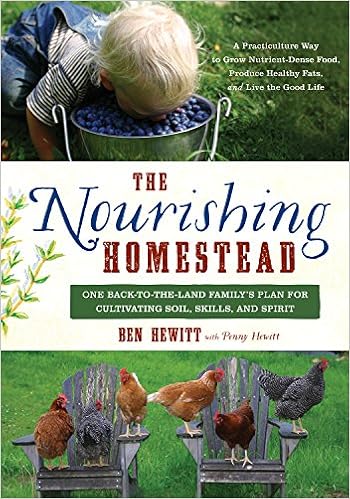
The Nourishing Homestead - Book 42

The Nourishing Homestead:  One Back-To-The-Land Family's Plan for Cultivating Soil, Skills and Spirit by Ben Hewitt 


This was a really interesting read.  My daydream is to be a homesteader which will never happen as I am too old and so coming to it too late.  But I deeply admire those who turn their back on the shallow, consumeristic, rat race world and take the path less traveled (in modern times; it used to be the more traditional way of life!).   This book is part memoir and part practical guide.  Ben Hewitt and his wife Penney have been homesteading for 18 years on a 40 acre farm in Vermont.  They have two boys they are raising on their farm (and unschooling!).  He traces their beginnings and their initial vision through how it is has evolved and shifted.  They started out wanting a simple, counter culture life who didn't really know what they were doing,  but have found their methods and vision have changed over the years.  They have moved to a more permaculture, regenerative style of agriculture with a focus on soil health and perennial planting.  When they started they were both vegetarians but  now raise and harvest their own meat.  For many years they were entirely off grid until they realized they could actually be a bit more self-sufficient if they could use a little bit of electricity from the grid (with back ups!).  However compared to the average household in America, they use an absolute pittance because they only use it in areas where it is absolutely necessary.  They went from being those who just didn't 'do' guns to gun owners who see them as necessary to their homestead. 

I enjoyed reading about the evolution of their homestead and the principles they embrace and want to live out in their lives.  Hewitt doesn't dismiss the physical labor aspect of it, how much is trial and error, how little disposable income they have and how finances are always looming as a consideration. But he wouldn't trade it for all the world.  He makes some income writing and otherwise they are mostly self sufficient.  It seems to be a deeply satisfying, family-centered, nourishing and beautiful way to live.

After introducing us to their story and their philosophy of life, Hewitt gets practical.  The various chapters cover homestead design, growing nutrient dense food, soil science, raising healthy livestock, animal slaughter and processing, infrastructure, skills and tools, dealing with financial limitations, and finally raising children on a homestead.  The chapter on skills and tools I found especially interesting.  He talks about learning to use a chain saw, how they got and use their tractor, etc.  Just lots of insider tips on how to manage things.  I read this book on my Kindle but I think if I really needed to use it as a reference if I ever did get a homestead, I'd want it in book form. 

If you like reading about life in the country, this book is for you!  For more book reviews go to Read 52 Books in 52 Weeks.