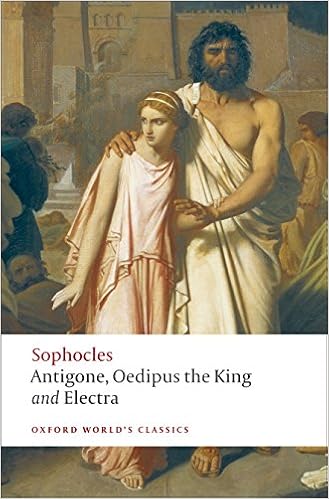
I read this collection of plays by Sophocles.
Antigone is the first play in this book, though chronologically it takes place after the events of the 2nd play, Oedipus the King. However, apparently Sophocles wrote it first so the Oxford World's Classics ordered them according when Sophocles wrote them and not when they occur in the time line of the trilogy.
Antigone to me is about the fact that natural law is higher in authority than man made law. If the man made law jives with the natural law, that law written on the human heart that people naturally intuit, then the man made law is just. If the man made law contradicts the natural law, then one's allegiance is to the natural law.
Backstory: Oedipus Rex and his wife/mother Jocasta are now dead. Their four adult children live, two men and two young women. The brothers take different sides in a civil war and wind up killing each other on the battlefield. The two sisters, Antigone and Ismene are now bereft of their brothers. Creon their uncle has assumed the throne and he immediately promulgates a law that Polyneices the brother who fought against Thebes, should not be buried according to the rites deemed crucial to entering the underworld. Antigone defies this proclamation and tries to bury her brother anyway. Ismene makes a plea for the authority of Creon, whether right or wrong. Antigone was engaged to be married to Haemon, Creon's son. Creon is insecure in his power and leadership since he has just ascended to the throne so he is fairly paranoid that people will defy him. He first hears Antigone's defiant statement of guilt for doing the forbidden act of burying her brother. Then he hears his son, who starts off being obedient and respectful but gets so incensed at his father's pigheadedness, he winds up breaking with him. Then the blind seer Tieresias comes in and also gives a pretty blunt warning. Even though Creon doesn't want to lose face in front of the prophet, as soon as he is gone, he turns to the chorus and admits that now he's frightened and he better undo what he's done. But alas too late. He had sealed Antigone up in a cave to starve to death. When he hurries to release her after his change of heart, he finds a tragedy. Antigone has hung herself. And his son Haemon is weeping over her body. In a rage at his father he lunges at him and then realizing what he's done, he turns his sword on himself and kills himself right in front of Creon. Creon's wife Eurydice hears of the suicide and runs into her palace to kill herself. Poor Creon.
Why did the translator sometimes use God with a capital G and sometimes use god? I found that odd.
Oedipus the King
Problems I have with Oedipus. First of all he shouldn't have murdered anyone on the road from road rage! Doesn't this show a bad side to his character? Why isn't this enlarged upon? It's the idea that he accidentally killed his father, which he was actively trying to avoid doing, which seems to be a greater sin than just losing his temper and murdering 5 people on the road one day. This strikes me as off!!! Also, didn't he notice that Jocasta was old enough to be his mother? I mean I think that if I had been warned that I might marry my mother, even if I assumed (from incomplete knowledge) that this wasn't my mother, I'd have sort of categorically refused to marry anyone who was that old!
I really think that what is missing here is the idea of sin. Oedipus had no intent to do the things he was actually fated to do. So he is innocent in that 1) it was fate, not him 2) he tried avoid all this happening But still even though he isn't at fault (except for killing the man on the road who turned out to be Lias his father) he is condemned and shamed, etc. I get that the ironic twists and turns are what the play is about, but this lack of intent bugs me.
Electra
I had not read this play before so I didn't really know the plot. However, I was a little bit familiar with the murder of Agamemnon when he returned from Troy by his wife and lover. I don't think I really knew about Orestes and Electra.
It's all about vengeance. They kind of leave the sister of Electra hanging. She serves as the same type of foil to Antigone's sister had served; the voice of prudence and conformity. Also this features a sister's issue with a brother! Electra wants her exiled brother Orestes to come back and kill their mother and lover who had murdered Agamemnon. The irony that jumped out at me was Clytemnestra's excuse for killing Agamemnon was due to the fact that he was forced to sacrifice a daughter to the gods to save many. But she doesn't care about any of her other children. Another bit of irony was that Electra who has been obsessively holding on to the idea that Orestes will come back and avenge their father's murder, but then doesn't recognize him. And she doesn't recognize the tutor she gave him to as a baby to smuggle out.
And again, the weird reference to God, ex. 'I pray to God', but then gods and names of specific gods. Was this an example of the translator christianizing the text?
I am glad I read this! This fulfilled my Classic Club spin. Hooray! Slowly working through that list of 50 classics!
For more book reviews, go to Read 52 Books in 52 Weeks.

No comments:
Post a Comment