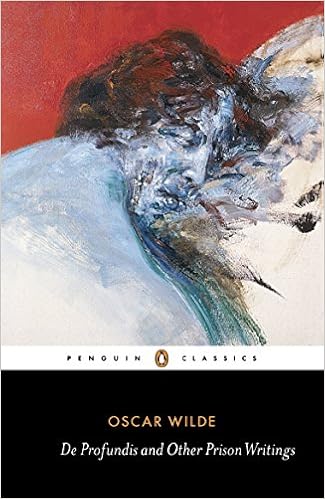
 |
| I actually read a free kindle version that only had De Profundis and not the other writings. |
De Profundis is really a long letter written to Oscar Wilde's lover, Lord Arthur Douglas. Douglas was the one who precipitated Wilde's trial and imprisonment. There is reason to think he, though 16 years younger than Wilde, influenced Wilde to do really degenerate things. And he sponged off Wilde financially causing his bankruptcy. And yet after Wilde's release from prison when he was living in poverty in exile in Paris, and Douglas came into his inheritance, Douglas would not help Wilde out at all. He completely rejected him. Poor Wilde, Douglas was a scumbag and Wilde's obsession with him is tragically pathetic.
The Latin phrase 'de profundis' means 'out of the depths' and refers to the divine office reading for the dead. Wilde, during his two year imprisonment was full of self-pity even as he strove to overcome his bitterness and make his tragic fall about something higher. It vacillates between noble ideas of art and faith and feeling sorry for himself for being so (in his eyes) unjustly condemned. On the one hand some of his writing absolutely soars like a gorgeously sung aria, but on the other hand, his narcissism bleeds through, his tragic flaw that was Wilde's undoing is there on display quite poignantly.
The saddest thing is that the letter ends on a high note, with Wilde hoping his art will never abandon him and yet, he really was finished. His last few years were spent in poverty and exile, drinking beyond his means, literally begging for money on the streets of Paris. His wife had died. His mother died while he was in prison, her death possibly hastened by his downfall. He was never allowed to see his children again. Though when he cries out about that in De Profundis, I felt angry at him! Because he did not care enough about the children to be faithful to their mother or to even spend time with them. He would go off for months and not bother to even spend Christmas with them some years. He was too busy leading his double life and diddling with teenage prostitutes. I think he liked the romantic idea of childhood, but his narcissism prevented him from any sort of healthy love. He could be kind and charming when in the mood and his sons had that memory of him. His oldest son was killed in World War 1. His youngest though went on to live a long and successful life.
Just as I was reading this book, one of my sisters unearth old footage of my father's Navy squadron from World War II. He was a fighter pilot and participated in both the Iwo Jima and Okinawa battles. He was shot down in one of them, though I don't know which. Luckily he was only in the water a couple of hours before a ship saw him. But when I think of all the sacrifice so many unknown men made, when I think of other prison accounts like St. Paul's or Nelson Mandela's, or someone like Father Walter Ciszek spending decades in a Soviet prison and gulag and how lacking in self pity they were and they were indeed, unjustly imprisoned, Wilde comes off as a real wimp. Poor little rich boy. Today is All Soul's Day though and I find myself praying for Oscar Wilde. He could glimpse the beatific vision, but he was so lost in his own narcissism, he wasted so much. On his death bed, he converted. May he rest in peace!
For more book reviews go to Read 52 Books in 52 Weeks.

No comments:
Post a Comment