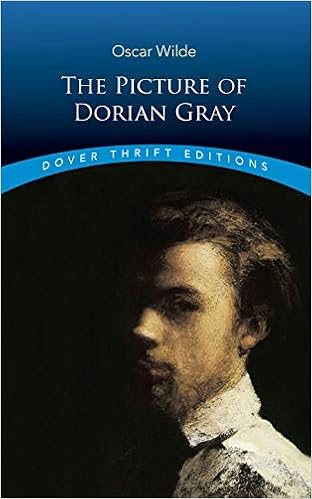
I read this book as part of the booktuber world's Victober, when you read lots of Victorian writing during October. I had actually read this book back a long, long time ago but had been wanting to reread it anyway, so Victober provided a good excuse.
The Picture of Dorian Gray by Oscar Wilde is a richly written, clever and well paced novel about three friends, Dorian Gray, a young,handsome innocent, Basil Hallwood, a painter, and Lord Henry Wooten, who basically plays a debonair Mephistopheles who lures Dorian into a life of evil. Lord Henry is extremely witty and always turns everything on its head, morally speaking, through his entertaining play with paradoxes. He confuses most people who laugh at him and consider him a good guest at a dinner party, but to impressionable Dorian he is wise and wonderful. Dorian falls under his spell. Lord Wooten grooms him and slowly seduces him into a life that thinks only of pursuing pleasure. We then witness Dorian sinking further and further into a life of selfishness and sin.
Wilde's own life is reflected in this book. Both Dorian Gray and Lord Wooten portray aspects of things characteristic of Wilde's own trajectory towards a sordid end. Dorian Gray has been influenced by Lord Wooten and by a book that Wooten gives him. Wilde had also been influenced by certain literary celebrities in the decadence movement of the Fin de Siecle era. The book that had so much further influence on Wilde was by a Frenchman Huymans, who wrote A Rebours, which basically touted that living a life of pleasure and sensation was the only way to live a life of beauty.
Wilde is also Wooten though as well. Wilde loved to groom and collect beautiful young adoring men around him to worship his wit and style. Wootens clever party repartee directly echoes Wilde's ability to be brilliantly witty.
The whole story is a morality tale that pretty much parallels Wilde's own life. He sort of predicts his own end. Dorian Gray, his conscience numbed by Wooten's influence and by years of doing selfish, sordid things, begins to realize that this is the path to ugliness and not beauty. He tries to turn his life around but he is so steeped in his own narcissism, he can't really do it. That part really reminded me of the Flannery O'Conner short story A Good Man Is Hard To Find, in that just as a character thinks they realize the true nature of evil, their completely inadequate grasp knocks them dead.
Wilde was a gifted author. His prose is gorgeous and flows like honey and is smooth as silk. But ultimately it is about bored rich people's self-indulgence that spread harm and grief to many. Poor Oscar Wilde, he gave us a lot but he has a lot to answer for as well.
In spite of the troubling nature of this book, there's a reason it is so well respected. It is a morality tale that has so many different levels to it, one could read it over and over and discover more nuance.
For more book reviews, go to Read 52 Books in 52 Weeks.

No comments:
Post a Comment