Sunday, June 9, 2019

No Wind of Blame - Book 20


I'm moving through the Georgette Heyer mysteries like munching through a bag of potato chips!

No Wind of Blame did not disappoint.  This time the rich landowner is Ermyntrude a chorus girl from the second row who married a rich first husband who left her everything when he died.  She's moved to the country to try to fit in with the landed upper crust to help her only daughter, Vicky land a rich husband too.  But of course, though kind-hearted, she's witless.  She's married again, a good looking hanger on, who's turned to seed and become an alcoholic.  Not a pleasant husband.  His ward though is nice, Mary Cliffe, and we sort of see the whole mystery from her point of view.  Ermyntrude hosts a shooting party weekend but her husband winds up being shot.  Who did the dastardly deed (although no one is sorry to see Wally dead)?  Could it be the foreign Russian prince, ousted by the Bolsheviks and now, in exile, angling for a rich wife?  Or the neighboring farmer, who has been in love with Ermyntrude since he moved in next door?  Meanwhile there are subtle romances going on among the younger characters, but will the right people end up with the right match? 

I thought the plot to this one was especially clever. Very enjoyable!

For more book reviews go to Read 52 Books in 52 Weeks.


Sunday, June 2, 2019

A Blunt Instrument - Book 19


Next, chronologically, in Georgette Heyer's murder mysteries (all written in the 1930s - 1940s) that I am currently plowing through, is A Blunt Instrument.  This one was wonderful and I guessed correctly whodunit!  Maybe guessed is too strong a word, because I don't have that much confidence in my sleuthing abilities, but I did register a strong suspicion which proved to be correct.

Inspector Hannasyde and his sidekick Detective Hemingway try to puzzle out who hit Ernie Fletcher over the head with a blunt instrument while he sat at his desk in his study.  Turns out Fletcher had a seedy side to him and lots of people were coming in and out of that study that night.  And then halfway through the book, just as the two intrepid detectives think they are on to something, their prime suspect gets murdered too.

There's a lot of fun, eccentric characters, including a scripture quoting policeman on steroids.  The way Hemingway and Neville Fletcher, the nephew, interact with him is laugh out loud funny.  Really clever.  Heyer had to do a lot of mining for obscure Old Testament quotes for this one.

A really fun book I read in 3 days.  Two thumbs up!

For more book reviews, go to Read 52 Books in 52 Weeks.

Thursday, May 30, 2019

Forgotten Women Mystery Writers

I'm posting this link here because I'd love to explore some of these books.  I've read Mary Roberts Rhinehart, Georgette Heyer (I'm in the middle of reading all of her mysteries, but I haven't gotten to the one they mention here), and Josephine Tey.  But I am excited to read some of the other authors listed here.  Yippee!


Tuesday, May 28, 2019

Framley Parsonage - Book 18


Framley Pasrsonage by Anothony Trollope is the 4th book in the Chronicles of Barcetshire.  In this book we meet some of the inhabitants of Eastern Barcetshire, Lady Lufton and her son Lord Lufton, and the vicar she has given a living to, Mark Robarts.  Mark was a school friend of her son's who she took under her patronage.  She even found him a lovely wife, Fanny.  Now at about the age of 25 he is married, has a job as clergy, having all his life been obedient and compliant to his father and his patron.  But, alas, he goes astray.  He has ambitions of moving in higher circles, so against Lady Lufton's good judgment, he allows himself to become entangled with Mr. Sowerby, a debonair lawyer chronically in debt and with the bad habit of exploiting his friends for money.  Mr. Sowerby is almost the undoing of Mark.

There are several plot lines going and we meet new people but also revisit many people from before, most enjoyably Miss Dunstable.  But we also re-encounter Archdeacon Grantly and his wife Susan,  Mr. and Mrs. Arabin, and the Bishop and Mrs. Proudie.  There are several romances going on, all at different levels of actual affection and social climbing.  But the sweetest and main romance is between Lord Lufton and Mark's youngest sister, Lucy.

I thoroughly enjoyed this novel.  It is full of wisdom and gentle humor and rings true in how the author depicts the foibles and failings, nobleness and fortitude of all the various characters.  There is a lot of satirizing of contemporary to Trollope's time politics.  I had trouble understanding exactly what this was all about and found the notes at the end of the book highly valuable.  Trollope loves throwing in a Latin quote or two and lots of references (in a tongue in cheek way) to Roman mythology.  The end notes helped with all that.  My Kindle edition was Oxford World's Classic, edited by Katherine Mullin and Francis O'Gorman.

Two thumbs up!  For more book reviews, go to Read 52 Books in 52 Weeks.

Sunday, May 12, 2019

They Found Him Dead - Book 17


They Found Him Dead is the 3rd mystery I've read right in a row by Georgette Heyer, featuring her favorite Scotland Yard detective, Inspector Hannasyde and his sidekick Sergeant Hemingway.

We have the same theme going as in the last two mysteries, the head a of rich family dies and the family is thrown into a tizzy with much questioning about heirs.  In this case, Silas Kane has just turned sixty and goes out for one of his nightly walks along the seaside cliffs, except this time they find him dead at the bottom of a cliff.  Is it an accident or not?  The heir is Clement Kane, an unhappily married man whose beautiful wife is about to leave him for another.  But now he's rich, so selfish Rosemary decides she'd rather stay with a rich husband then throw it all away on a tempestuous affair.  Alas, Clement is shot dead while sitting at his desk in the study.  Someone must have shot him from the garden.

Lots of characters again and lots of wonderful dialogue, though I have to say I didn't think the characters were quite as well fleshed out in this one as in the former two books.  We have Mrs. Emily Kane the old lady and matron of the house, her snippy but loyal maid, Ogle, and Miss Patricia Allison, who works as Emily's secretary and companion.  Miss Allison becomes engaged to Jim Kane, the next heir in line and Emily's favorite.  We also have Silas Kane's business partners, the Mansells, who seem bent on investing the Kane money in a risky business scheme.  And then there's also Jim Kane's 14 year old half brother (my favorite character in the book) Timothy, Oscar Roberts, a visiting Australian business man who takes great interest in trying to find out who the murderer might be, and Jim Kane's delightfully eccentric step father, Sir Adrian Harte, and intrepid world traveler mother (who returns from her exploration in Africa to run for parliament), Norma Harte.

Usually I just read mysteries for the pleasure of seeing the story line unfold.  I'm terrible at guessing who did it (unlike my husband who nearly always guesses right).  This time I tried to guess and was completely wrong.  Looking back though I can see plainly that there were definite clues I just didn't put together.  Alas, I will never make a good detective!

Two thumbs up!  I am highly enjoying these wonderfully written mysteries, but right now I'm going to take a break from them and go back to my Anthony Trollope challenge.  However, I am looking forward to spending the summer reading all of Heyer's mysteries.  I believe she wrote eight of them.

For more book reviews, go to Read 52 Books in 52 Weeks.

Sunday, May 5, 2019

Behold, Here's Poison - Book 16


Behold, Here's Poison is the second in Georgette Heyer's Inspector Hannasyde series.  We meet the good inspector again as well as his assistant, Sergeant Hemingway.  And we even have Giles Carrington as a minor figure.  Giles was the solicitor and love interest in the first book, Death in the Stocks.

Horrible uncle Gregory Matthews is found dead one morning and the rest of the family is thrown into a dither because domineering, officious Aunt Gertrude insists on a post-mortem.  She's got an instinct which turns out to be right.  Uncle Matthews has been poisoned.  Who did it?  Everyone in the family had a reason to hate Uncle Matthews.  Inspector Hannasyde is called but he can't make any headway.  But the heir and new head of the family, Randall, knows something he isn't telling.

The character development and the dialogue are so fun.  Randall is just like one of Heyer's regency heroes, at first he seems too smart and too malevolent but slowly he grows on you and you begin to suspect he is actually much worthier than the rest of the family.    There's a cast of characters in this book:  Miss Matthews, Mrs. Mathews, Gertrude Lupton, Mr. Lupton, their two daughters, Guy and Stella, who are the young adult children of Mrs. Mathews, Dr. Fielding (Stella's fiance), and the next door neighbors Mr and Mrs. Rumbold.

Two thumbs up!  I'm having a wonderful time reading through Heyer's mysteries.  For more book reviews go to Read 52 Books in 52 Weeks.

Sunday, April 28, 2019

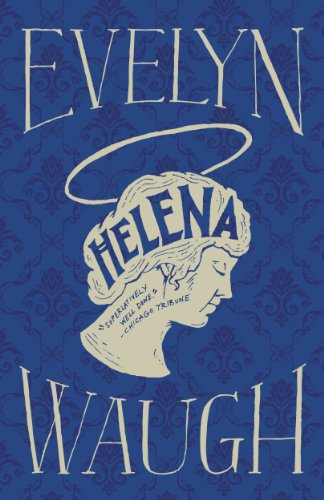
Helena - Book 15


Helena is a novel by Evelyn Waugh of Brideshead Revisited fame.  Waugh was raised Anglican, became an agnostic for many years and around the age of 30 converted to Catholicism.  Helena is his fictionalized story of St. Helen, the mother of Constantine and the supposed discoverer of the True Cross, a famous relic, pieces of which are found in many churches.

This book was my Classics spin for the Classics Club, which gives me until May 31 to finish the book.  However, it only took me three days to read.  I found it very hard to put down and it is not at all a long novel.

From the BBC series Brideshead Revisited.  One of the best adaptations ever.  But the book is still better!

Waugh is a master wordsmith.  His precision in creating characters and the mood of the novel, the dialogue, the pacing, the deeper story going on, all the while conveyed in the subtlest way, is really captivating.  Waugh says this was his favorite novel.  I can see why.  Waugh moves deftly in telling a fictional tale of a young girl married off to a Roman soldier without any idea of who he really is.  He is of the great families that struggle to rule Rome.  He bides his time and eventually, after decades, gains control.  At first Helen is happy and in love.  She bears him a son, Constantine whom she raises lovingly in her palace in Asia Minor until he is 14.  She is a clear sighted soul, who sees the evil the murderous power struggle that is eating the Roman Empire for what it is.  She is never seduced by power.  Instead, in her pagan way, she longs for truth.  She longs for a reasonable answer to her deeper questions.  She is of a stoic bent though and accepts her lot and the heartbreak it brings.

Throughout the book the rise of Christianity is hinted at.  it is mentioned here and there, but most people seem to have it all wrong.  It is all twisted up with a pagan understanding, seen as just a cult like the many other cults that are brewing at the time.  Constantine has his vision of the cross and wins the Battle of Milvian Bridge.  But he's all twisted too.  When Helena is allowed to visit him in Rome after years and years of never seeing him, she sees what the sordid insanity of Rome has done to him.  There are glimmers of the old Constantine, her child, but his mind has been demented by so much killing, manipulating, spying and paranoia.  He's banking on Christianity though to bring his kingdom together.

I felt the same admiration for Waugh in the way he presents the sordidness of Rome without ever really depicting it graphically, as I did when I read that great novel of early Christianity, Quo Vadis.  The reader feels how utterly creepy and unhinged the whole atmosphere must have been, thus making the intelligent charity of Christianity seem like such a breath of fresh air.  One can see why it was so very attractive and why it gained in popularity.  The world was suffocating under the unmitigated vice of the Roman world.

St. Helen finds the True Cross

Helena finally finds her purpose in her old age.  She converts, Waugh doesn't go into details at all, with great effect.  Instead she pursues her final goal, to find the true cross.   Waugh also uses anachronisms to great effect.  He's playing with our sense of history.  At one moment we are in the 300s A.D. but at other moments we in the 20th century looking back and using analogies from our own time to illustrate what's taking place.  He does this seamlessly without any feeling of strain for the reader to jump in time that way.  That to me was masterful storytelling.

The one disturbing irritant in Waugh's writing is that he always brings in the British sense of superiority/bigotry in the way he depicts blacks and Jews.  He was unfortunately a man of his time in that way.  He always seems to have to get a few digs in.  So there's a great inconsistency in his faith; he so deeply understood so much of it, as is evident in the power of his writings, yet he never could overcome the cultural bias he was raised with.

In spite of that, I thoroughly enjoyed this novel.  For more book reviews, go to Read 52 Books in 52 Weeks.