Lots of stuff from the CSA: carrots, chard, cucumbers, weird kinds of squash I have no idea how to cook, freshly dug potatoes, three more pasture-raised chicken from local farm.
I'm going to cook up the chard today. At some point this week, I'm making carrot slaw. I think I'll roast some potatoes and weird nameless squash along with a chicken for dinner. Right now I am out on my screen porch. The temperature is lovely this morning. Nice and cool.
B starts her camp today and I am not prepared to make her lunch. I just didn't think ahead. The weekend was very busy with AHG stuff and other things. Must make amends now.
I think my hour of decluttering is going to be cleaning out my freezers. Talk about wasting food and plastic. My out door freezer is such a mess. But I might as well bite the bullet and clean it out. I need to defrost it too but since I have 5 chickens in there right now and no room to put them anywhere else, I'll have to postpone that.
Yesterday, we went to a pizza party for AHG and ate so much junk. Junk, junk, junk. Honestly we need a real change in our diet. B eats so poorly and is always complaining about how lousy she feels. She's put on weight and she's so moody. She feels like crap. I think it is the cumulative affect of eating so poorly. How to change things for the better? And now she is going to be at this theater camp for 2 weeks and the folks there live on candy. I mean bags and bags of it.
B's birthday is Wednesday. We are taking her to out to dinner (good restaurant) and then to the Kennedy Center to see The Sound of Music. Weirdly, I think it is just going to be her, R and me. A very quiet birthday. But we owe her a whale watching trip! We are going to try to plan ahead for a fun trip at some point in the next year; maybe New England, maybe California. We need one more big family trip before she graduates high school. Once they get to college age, it is much harder to get them to come to family vacations.
Anyway, I am just rambling. Need to focus on meal planning for the week but that might not happen until tomorrow.
Monday, July 10, 2017

Sunday, July 9, 2017
Life on a Virginia Farm - Book 21
I discovered this little treasure on the shelf of my local library. It was published back in 1968 and it is the memoirs of a man born in Fauquier County in 1879. It really seems like a collection of essays he wrote over the course of years and some letters too.
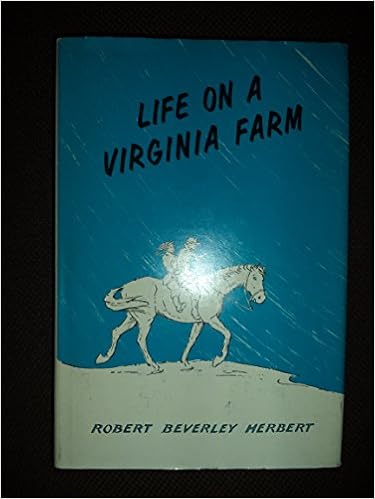

Robert Beverley Herbert loved his grandparents huge farm called Avenel. He really doesn't talk much about his father and in fact he does not have his father's surname, which was Pinkney. He did have a sister and a brother. The sister died of diphtheria. He does mention his younger brother occasionally. His mother hardly gets a mention at all either. She died before he was 13 and he and his brother were sent off to boarding school. For Christmas and summers they came home to their grandparents farm. Robert loved it with a love he had all his life. He admired his grandfather and his grandmother immensely.
The neat thing is that the book is full of local history. Fauquier County is two counties away from the one I live in. We used to go there near Marshall, near where this book is mainly set, to buy beef from a farmer there. The countryside is beautiful but is now being built up and becoming an exburb. Apparently where Avenel once stood there is a housing development named after it. A really poignantly sad ending to this beloved place. I especially was charmed by the book because when I did the National Novel Writing Month in November of 2014, I set it in that county around Warrenton back in the 1960s. I was kind of thrilled when I happened to take this book off the shelf and realized what it was.
The book is a meandering, nostalgic look back at a different time, 'horse and buggy days', the author calls them. He remembers the blind horse he and his brother rode, how poor and cold they were until their grandparents took them in, how much he loved the countryside and the people who lived near him. Another really insightful element to the book is his fond remembrance of stories told about Robert E. Lee and Col. Mosby. While the author acknowledges that slavery was wrong, most of his memories are of the stories told of great deeds of courage carried out by noble soldiers of the Confederacy. He says when he was a boy everyone talked about the weather and the Civil War. The whole mythology was already fully blown.
If you know this area this book is really fun to read. There is so much local history and lore, and explanations of flora and fauna in a very homey, genteel telling.
I googled a map of this area and I found this one. The author was related through his mother's side to many of the founding families of Virginia. The big missing factor in this book is a harder look at slavery and prejudice. However, to be fair, the author whitewashes his own history by avoiding what was too unpleasant or only giving it the slightest passing glance. He wanted to talk about what he loves, not what he doesn't love about his beloved Fauquier County.
A charming walk down memory lane for Virginians.
This book fills the square for my Local Author requirement in the 52 Books Bingo Challenge.
For more book reviews, go to Read 52 Books in 52 Weeks.
Saturday, July 8, 2017
Current Projects - July 2017
I feel the need to un-jumble all the stuff that is going around in my head.
In my head, summer didn't really start until S left for Boston for 5 weeks. Now I need to get serious about things I wanted to get done this summer, balanced with ongoing stuff as well as planning for the fall.
Summer Projects:
1) Decluttering the house - room by room, drawer by drawer, I hope to get a substantial amount of decluttering done this summer, starting today. My goal is whenever I can Monday-Saturday to focus on decluttering from 9:00 a.m. to 10:00 a.m. My reward will be to take a shower at 10:00! If I am really getting into it, I'll have time later in the day to continue, if I feel like it.
2) Reading Teaching from Rest with the Catholic Relaxed Homeschoolers facebook group. This will start next week at some point.
3) Work on American Solidarity Party stuff - podcast, state chapter meetings, various events.
4) Drive people places - S is away for now but I still need to take V and B places. Hopefully, V will get her driver's license this summer and B is supposed to be working on it as well. J says he'll teach V driving. She actually already knows how, she just needs to pass the driving test.
5) I really wanted to learn to crochet this summer.
Ongoing Projects:
1) Work on my zero waste efforts
2) Moderate Catholics for Zero Waste facebook group
3) Re-establish house cleaning schedule.
4) Keep up on my Latin skills - they disappear if I don't do something with Latin a couple times a week at
5) Finish reading City of God
6) Our backyard fence is really falling apart. We want a new one and to reconfigure the backyard. R says maybe we need to do some leveling. Might need a landscaper.
7) Attend to Eileen's issues.
Planning for the Fall:
1) Aquinas Learning Planning - this could take up a huge chunk of time. I am not sure at this point what classes I am teaching and I have no idea what syllabus to use. Trying not to panic!
2) American Heritage Girls planning. My co-leader does most of this (I am more of an assistant), but I am going to lead the Cooking badge work.
3) Planning a garden in the fall. A)I want to put a sycamore tree where the silver maple use to be (had to cut it down because it was dying). B) I also want to fill in empty spaces in garden by the house by getting rid of dying bushes (something is killing them slowly) and replacing with azaleas and ground cover like Silverpire. Both are natives to this area and good for pollinators. The sliver spire I am looking at the Henry's Garnet which has white bottle brush flowers in the spring and turns a beautiful bright red in the fall. C) Prune cherry trees (late summer/early fall) D) Plant more hydrangeas along the fence line.
4) Plan Environmental Science and Ancient History for B. Ancient History I pretty much know what we are doing. We'll watch the Western Civ Great Courses video lectures each week and then make a timeline of people/events he talks about. Environmental Science seems more of a problem in terms of planning. Don't want it to be boring textbook stuff, but more multimedia and hands on.
Friday, July 7, 2017
Photo Friday - 7/7/17
 |
| Just left for the airport. He'll be gone for 5 weeks at least, studying flute and all things music. |
Thursday, July 6, 2017
My Hypothetical School
For years now I've daydreamed of having my own little cottage school. And one of the things I'd do in the school is have the kids cook their own lunch. Apparently, the Japanese thought of this before I did!
I have it all planned out in my head.
8:30 to 9:00 would be Morning Sing. The kids would gather for announcements and then we'd sing! All kinds of songs of different types, maybe in different languages. The kids would learn good posture and breath control, harmony and everything good that singing does for you. St. John Bosco thought teaching kids to sing was important; it was an essential element in his schools.
9:00 - 10:00 would be Exploration and Discovery. This would be set up sort of like a Montessori school with learning stations. I'd make this partly democratic to a certain extent in that the students and parents could vote on the themes to be explored. I think this would mostly be about science and math with some history, art and geography thrown in there as well, because you can't really separate out subjects. Everything is interrelated. There would be activities, experiments, demonstrations, things to read, things to write. The older kids could help the younger kids. And if a kid just wasn't that interested in whatever was being presented, they could go read their own book or play chess or something. The themes would go on for a while. For instance maybe one month would focus on physics and simple machines. The next month might focus on another aspect of physics. That sort of idea.
10:00-11:00 This would be Read Aloud time and Recitation time. Read alouds would be classic works, a la Charlotte Mason. Probably the kids would be loosely divided by age; older kids in one group; younger kids in another. This would also be the time when kids could recite anything they'd memorized: poetry, speeches, math formulas, whatever. We'd give the parents a list of suggested things to memorize at home. That would probably be the only homework most of the time. This is the one thing that I'd reward in some way to get the kids into maybe some gentle friendly competition, kind of like Anne of Green Gables and her school's recitation performance. If the kids got fidgety during the reading/recitation, they could do things like finger knit or real knitting or sketching or any kind of quiet activity as long as it didn't distract anyone else and they could still listen. We'd do the Charlotte Mason narration techniques too, to train the kids in really listening.
11:00-12:00 outside exercise/indoor play - Kids need tons of physical exercise. Whenever the weather was tolerable the kids would go out to walk, or jump rope, or play kick ball or hopscotch or whatever. I believe as long as it isn't freezing or pouring rain, kids can dress for the weather and get outside. Put some roses in their cheeks! Maybe we'd have a garden on the property and kids can work there too.
12:00 -12:30 - Kids would alternate cooking duties for lunch. So some would have to come in early from the 11:00 recess to help. Parent volunteers or maybe we'd hire a cook to oversee things would help prepare simple but nutritious meals with the kids. This all would have to planned out well and probably started earlier in the day. We'd use real stainless steel cutlery and real plates and cups. And there'd be another group of kids who'd be on wash up duty. And everybody would be responsible for cleaning up their own tables.
12:30 - 2:30 - the afternoon would be a quiet time of independent or small group study. We'd focus on the basics of reading, writing, arithmetic, and drawing. And Latin too! Short, pithy lessons.
2:30 - 3:30 - Free time/clean up time. Kids can play games, work on learning musical instruments, read, etc. The last 15 or 10 minutes would be tidy up time.
That all would be for Mondays through Thursdays.
Fridays would be different. Fridays would be reserved for special P.E. stuff like ice skating, swimming and dance. I got this idea because when we'd go to our homeschool ice skating on Friday mornings, the local Montessori school would be there too. So you could do dance (Irish, tap, hip hop?) in the fall, skating in the winter and indoor swimming in the spring. We'd also schedule field trips for Fridays or have special visitors or events at the school. And perhaps we'd end each Friday with a meeting of the school where we'd figure out how things were going and get input from everyone.
Wednesday, July 5, 2017
Anxiety and Homeschooling

Homeschooling invites anxiety. The parent feels they are taking on an enormous responsibility. They are taking a different road and see themselves as only successful if in the eyes of the world if their children not only succeed but live up to very high expectations. The parent must prove to everyone and herself that she has done the right thing, the best thing for her child. There are standards to meet; there is the intimidating goal of getting that child into college. And everyone is watching!
This can be an extremely overwhelming endeavor. Many moms go through burn out. Many give up. They are always measuring themselves against some imaginary perfect standard and of course they always come up short. The imaginary standard is of the world and not of God. It is often one's own pride lurking under the veil of anxiety. It is not a prideful pride but a fearful pride. What if I don't measure up?
I am responded to a particular mom's cry for help. In her post she does what we've all done. She compares herself to others and she comes up short. She sees the system as stacked against her; an obstacle always looming in the distance. She sees unschooling as what you call it when you can't get to formal academics. She sells herself short by diminishing the huge fact that she works from home and has four children but she had trouble staying on top of things.
I am going to address each of these issues one by one. However, first it is good to talk about assumptions. A lot of times anxiety makes us work off assumptions that are faulty. We become our own worst enemies because we jump to conclusions that cloud the clarity of our thought processes. So for instance, the mom compared herself to her friends who are approaching homeschooling differently from her. Remember the adage: Comparison is the thief of joy! I had trouble with this bad habit of comparing and always coming out feeling dissatisfied and defeated. First of all, I bet the other family isn't doing as glowingly as you might think! I mean they are a human family so the odds are they also have conflict and bad habits! But even if they are going strong in their own groove (and that's wonderful) instead of comparing, wouldn't it be wonderful to be able to glean inspiration and perhaps ideas that fit into your homeschooling landscape? If you can't get inspiration or ideas, realizing in your heart that you admire the way they can do things that way but it isn't your way, is a fine response. Just resist that tendency to compare; it doesn't come from a good place!
One fear was the fact that the Department of Education is leaning towards everyone being enrolled. First off all, the thing to do is to look up actual regulations that are in existence right now. What exactly is required right now? If the DoE is 'leaning' what does that mean? It is easy to make this a looming fear that somehow the government is going to come and get you! Don't think about 'leaning' which is vague, think about actual requirements. Those actual requirements become part of your home learning landscape. You operate within that landscape. The second thing is that there are schools you can enroll in that unschool! So maybe you can do both! I don't know if the school has to be from the same country or not, but in the U.S.A. there is a long time school that children can enroll in and then are encouraged to learn from life and their passions. This is called Clonlara. There are others out there too. You could explore this option. I know way back in the day California outlawed homeschooling! So people got around this and simple made their own particular home school a private school. That might be another way around the issue. There are ways around this, but again it is hard to fight something that is vague and imaginary. You need the actual facts and then you can look for solutions.
Don't diminish how busy you are. If you are working from home and have four children that is an extremely tall order to fill! You have to be realistic in your assessment of what you can do. Working at home can lend itself to a delusional idea that since you are home you ought to be able to keep it clean and tidy and pay lots of attention to the kids. But in reality you are working and thus require dedicated time to do your work. You really can't juggle all those balls in the air at the same time. I have no idea how things work out for you, but maybe you get up early and while the kids eat breakfast and watch educational TV you crank out some work. Then maybe you could stop that and focus on the kids: cooking together, doing some chores, reading aloud, maybe working on project or going to the park or having a playdate. Whatever. Maybe in the afternoon the kids do quiet time and listen to audio books while you crank out some more work for a couple hours. Then maybe in the evening when your husband comes home, you get to work for a solid chunk of time while he having his time with the kids. That's just me imagining how someone might work that

Another comment was managing to squeeze in read aloud time. What does that mean? It sounds like maybe you are diminishing how much read aloud time there is? Is there more time than you give yourself credit for? Or are you truly struggling to get read alouds in? If you are struggling, I would recommend: 1) keep the read aloud time but realize you can only do it for a short period and adjust for that 2) rely heavily on audio books 3) Have your husband do the read alouds 4) make sure your kids have plenty of time for independent reading.
Finally, unschooling is not what you do when you can't get to formal academics. Often the conflict and problems associated with formal academics makes people consider unschooling, but unschooling isn't being passive or neglectful. It isn't giving up. Unschooling is placing priority on your child's projects, passions and talents by realizing they learn best this way. Unschooling is about creating an encouraging atmosphere that allows the child to thrive. Unschooling is rejecting (as much as is practically possible) the scope and sequence enforced from outside and letting him blossom in the way that is natural to him.
Oh wait! I have one more thought. Sometimes when the house is just too much of a wreck and you can't concentrate on anything because of that, it is good to give yourself permission to stop thinking about academics for a while and just work on tidying up. Tackle the things that bother you the most first. That huge stack of papers that keeps threatening to avalanche? That stubborn mountain of laundry that won't go away? That kitchen floor that is so sticky you can't walk across it without making enormous sucking noises with your shoes? LOL. Deal with the stuff that is super-bugging you. You'll feel release!!!!

Monday, July 3, 2017
Monday Musings - The Paradigm Shift that Frees the Homeschool
 |
| Photo taken from http://www.childrenandnature.org/connect/ |
There are two maxims that I believe lead to freedom when it comes to home educating your child. Realizing these was a real paradigm shift for me. The two maxims are:
1) Your child was designed to learn. This is how we have survived for millions of years. Human children develop slowly but they are sharp as tacks when it comes to absorbing knowledge. They are little sponges that are consciously and unconsciously soaking up everything around them. You can see this as babies develop into toddlers and acquire language. They begin to ask why about everything. They learn through imitation, conversation and play.
2) The drive to grow into a competent adult is in every child. Again, I look to our existence on this planet for millions of years. The end goal of that slow development where so much time is spent absorbing enormous amounts of knowledge is to become a competent adult. Competent enough to survive, mate and raise the next generation. This is why we are still here on the planet!
These two things are inborn to human beings.
If you accept these two maxims as true, then it is quite freeing! The burden is not so heavy on the home educating parent. You really don't have to do much except give the child something to imitate, someone to talk to and lots of opportunity to play. And as for the second maxim, as the child approaches adulthood, your job might be to guide the child in determining how to become a competent adult; we know he already wants it, but getting there might require some help.

The bad thing we can do is to diminish the insatiable curiosity and drive that children innately have.
One way to do this is to doubt that the child truly does have the wherewithal to learn. We can see them as the proverbial empty bucket that needs filling (and if we don't fill it, we are failing, we think).
We can force the child to develop in ways that are unnatural, for instance not letting them imitate, converse and play but forcing them to learn in ways that turn their natural excitement to learn about the world into a drab and onerous confinement.
We can panic about the child's possible slow development when compared to others and then we can try to push the child into keeping up with others, not honoring his innate, personal developmental arc.
We can decide that sound sleep, nutritious food, lots of exercise, and creativity are all 'extras' that can be ignored or dealt with shabbily and that this somehow won't affect the child's maturity or stunt his natural drive to learn and to grow.
 |
| I love this painting. I am sure Baby Jesus never ate dirt or bugs. |
Since I am Catholic I see these innate drives as God designed. God has a plan for each of us and his plan is reflected in how our children respond to the world we provide them. We need to honor the innate drives God gave his children and then we need to let our children blossom in God's good time. For many children the institutionalized scope and sequence is not reflective of God's timing. It does violence to the basic drives and needs of these children. It expects each child to follow some abstract average for things like learning to read that run contrary to the child's own personal developmental arc. This damages the child's desire to learn and to become competent.
If we really accept that we are made in God's image, then we should respect God's design. Let children learn through imitation, conversation and play and don't destroy that desire to grow into a competent adult by forcing arbitrary and unnatural practices on them that cause alienation from their healthy drives.
The hardest thing is to hold on to these two maxims as the children grow. Raising children is a long term project and often times it is hard to see the forest for the trees. Especially when we are constantly inundated with the idea that we must follow these abstract, institutionalize standards if we want to be good parents. Our children must learn to read at 5 or 6 or they are 'late.' All our children should be able to study calculus at age 17 or they won't get into college and will be failures as adults. This is the brainwashing we must constantly be vigilant against. It is an uphill battle that must be fought under constant scrutiny, judgment, and pressure. We are under constant bombardment! Our culture is toxic in so many profound ways. Even the best intentioned persons often don't realize the faulty assumptions they are operating under.
 |
| Why isn't Joseph wearing his kippah? |
There is release and joy in embracing these two maxims. It is freeing, truly freeing, to be able to relax and know God is with us and if we trust in Him, our children will be fine. We need to love and care for them, rejoice in their being, marvel at how they unfold as they grow. We need to nurture and guide them. We need to teach them to love love (and God is love). We need to let them be free to do as God wills, for doing God's will is the only true freedom (since He is Love).
A lot of secular unschoolers use the phrase 'trust the child.' But I prefer to think of it as trusting God. I trust the inborn drive to learn and to become competent that He placed there, because He loves His own.
Subscribe to:
Posts (Atom)