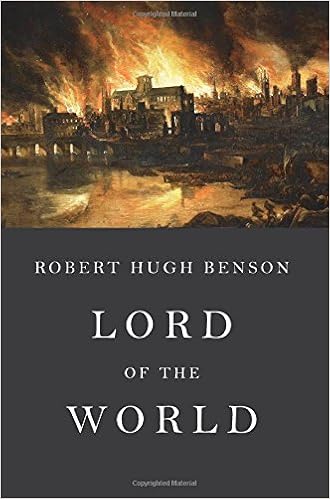
Since there is no study guide out there for this book, I wrote up my own. Nota bene: This book is really too hard for high schoolers. You simply have to have a larger and deeper context to draw from when trying to comprehend all that is in it. It is a deeply flawed and yet brilliant book.
Here is my rinky-dink Study Guide. It isn't really a study guide proper though. I just wrote a bunch of questions and some comments to provoke discussion with our little book club. Here it is:
Study Guide for Lord of the World:
When was this book written and what time period is it set
in?
Imaging the future, what does the author come close to
guessing pretty accurately and what does he assume to be the same as in the
future?
What aspects of the novel reflect the author’s time
period: (my answer: attitude towards women, women still wearing
hats with veils, liturgy being in Latin and as elaborate as a high Latin Mass,
communication is still by telegraph and newspapers, no A/C.)
What is futuristic in the book? (my answer: volors, electric lights, living
underground, placards on buildings that announce news).
In what ways does Mabel’s worldview parallel modern views on
euthanasia, globalism, and 1st world dominance over other parts of
the world?
Mabel and Oliver are both good people who are intelligent
and idealistic. What is it they lack
that prevents them from seeing the truth?
Why does Father Francis leave the faith?
What do you think the author is saying about the power of cultural influence
in determining our inner spiritual lives?
What does the role of the mother in law reverting to
Catholicism and then dying play in the novel?
How does the author’s imagined future foreshadow things like
the Soviet Union, the rise of cult personalities like Hitler and Lenin? The Holocaust?
How morally consistent is Mabel? Oliver?
Mr. Francis? Felsenberg? Write a
paragraph for each, explaining their reasoning.
There is a lot wrong with this book. For one thing he hardly never mentions Africa
once. It is as if it didn’t exist. Benson also seems to be anti-Semitic. Why does he pick the name Julian
Felsenberg?
He also has a thing against the Masons. What were the Masons at that time and why
does the Catholic Church not like them? Did you know there was an anti-Mason party at
one time in U.S. History? Here’s an
interesting link: https://en.wikipedia.org/wiki/William_Morgan_(anti-Mason)
Are Masons still
perceived as a threat? Why would the
Catholic Church be so against Masons?
Benson also seems to mistrust Democracy. This may be related to his anti-Mason stand
(just my own theory!) because many of our Founding Fathers were Masons. The Church had a hard time switching gears
from monarchy to democracy; (see this Wikipedia article: https://en.wikipedia.org/wiki/Relations_between_the_Catholic_Church_and_the_state
How do Benson’s views reflect this? How is it that the Church can change in terms
of political views and still remain faithful to her spiritual and moral
teachings?
How does the author’s depiction of the adoption and
corruption of so much of Christianity for the new religion reflect the defects
of a purely humanitarian understanding of existence?
What is so ironic about having Mr. Francis explain
Catholicism to Mabel? Why is it that he
is satisfied with his reason for losing his faith whereby Mabel sees in his
explanation a reason to sympathize with the Catholics?
Compare and contrast the faith life of Father Percy Franklin
with the faith life of Father Francis.
What makes Father Francis lose his faith and what makes Father Percy
keep his?
Do you see a parallel between decision made by Pope John and
decisions made by Father Percy (who becomes Pope Sylvester)?
What is the great internal contradiction of Humanitarianism?
Given all the flaws in this book, why would Pope Francis say
it is one of his favorites and encourage people to read it?
Why does the author tell us the ending through the eyes of a
new character, the Syrian priest?
In my opinion, Mabel a better person than Oliver even though
she killed herself. What do you think?
What exactly happens at the very end?
What is the Catholic understanding of the end of the world?
You might want to check out some of the following sections
in the Catechism of the Catholic Church in relation to this book:
Section # 676 – on the Anti-Christ and secular messianism
Section # 770 – the role of the Church in history
Section # 2425 – communism vs. free market

No comments:
Post a Comment